Author: Sun Brite Supply

  • Small Engine Repairs Special! Save $50 On Diagnostics Regularly Priced At $95!

    Small Engine Repairs Special! Save $50 On Diagnostics Regularly Priced At $95!

    Pay only $45 for Diagnostics on all small engine repairs and pressure washer pumps!  This includes snow blowers, leaf blowers, lawn mowers and any type of gas powered equipment you have!  Just load it up and bring it in the store and leave the rest to us! Our mechanics will diagnose each piece of equipment to see what type of repairs it needs to ensure that it’s in proper running condition so your equipment is ready to go when you are!<i>Small Engine Repairs</i> In Montgomery County Maryland

    Small Engine Repairs And Diagnostics

    Small gas engines serve us in many ways. They power lawn mowers, tillers, cultivators, trimmers, edgers, snowblowers, chain saws, pumps, generators, air compressors, pressure washers and other useful home tools. They also power our fun: outboard boats, snowmobiles, motorcycles, all-terrain vehicles, ultralight aircraft, and other toys. To keep them operating efficiently,
    an owner of these tools and toys should know about small engines: how they work and what to do when they don’t.

    Small gas engines are made up of individual systems that work together to produce power. Each system has many components.  Internal combustion gasoline-powered engines require six systems: fuel, exhaust, ignition, combustion, cooling, and lubrication. In this article, we will discuss the systems and components that make small engines work.

    The ignition is a primary system within all small gas engines. It produces and delivers the high-voltage spark that ignites the fuel-air mixture to cause combustion. No spark means no combustion, which means your engine doesn’t run.

    Below are the components found in small engine ignition systems. Some systems will include breaker point ignitions while others depend on solid-state ignitions.

    Magneto-Powered Ignition System: A magneto uses magnetism to supply electricity in ignitions where there is no battery.

    The magneto is turned by the crankshaft, which rotates when the manual recoil starter is pulled. The three types of magneto ignition systems are mechanical-breaker, capacitor-discharge, and transistor-controlled.

    Battery-Powered Ignition System: If your small engine includes a battery for starting, the ignition coil will also use it to supply spark to the spark plugs. A battery stores electrical energy until needed. Battery ignition systems also use mechanical-breaker, capacitor-discharge, and transistor-controlled ignitions.

    Mechanical-Breaker Ignitions: High-voltage electricity must be sent to the spark plug at the appropriate time. In mechanical-breaker ignitions, this job is performed through the contact points and a condenser.

    Points: As the crankshaft rotates, a cam opens and closes a set of contact points. These points function as an on/off switch: Closed is on, and open is off.

    Capacitor-Discharge Ignitions (CDI): A capacitor is a large condenser. A CDI stores and delivers voltage to the coil using magnets, diodes, and a capacitor

    Transistor-Controlled Ignitions (TCI): Transistors are electronic controllers. A TCI uses transistors, resistors, and diodes to control the timing of the spark.

    Coil: An ignition coil is simply two coils of wire wrapped around an iron core. The coil changes low voltage (6 or 12 volts) into the high voltage (15,000 to 30,000 volts) needed by the spark plug.

    Spark Plug: A spark plug is an insulated electrode that is screwed into the top of the engine cylinder. High-voltage timed electricity from the magneto travels by wire to the spark plug. The base of the plug has an air gap of about 0.030 inch (30 thousandths of an inch), which the current must jump.

    Crankshaft: An engine’s crankshaft is a metal shaft with an offset section onto which the connecting rod is attached.

    Rotation of the crankshaft moves the piston up in the cylinder. Movement of the piston down in the cylinder then rotates the crankshaft.

    Valves: Valves simply open and close passages. A reed valve in a two-stroke engine is activated by changes in air pressure.

    Flywheel: At the end of the crankshaft is a circular weighted wheel called a flywheel. The flywheel delivers the engine’s power to devices (wheels, blades, etc.) and helps keep the crankshaft turning smoothly.

    Cylinder Head: The cylinder head is the top, or ceiling, of the cylinder and is attached to the block with bolts.

    Depending on the type of engine, the head may or may not include valves.

    Piston: A piston is the movable floor in the combustion chamber. Its upward movement compresses the fuel-air mixture.

    After combustion, its downward movement rotates the crankshaft.

    Connecting Rod: Between the piston and the crankshaft is a connecting rod. At the larger end of the connecting rod is a bearing that allows rotation around the moving crankshaft. The small end is attached to the piston pin.

    The combustion system of a small gas engine is where the work gets done. Components of the combustion system include the cylinder block, cylinder head, camshaft, valves, piston, connecting rod, crankshaft, timing gears, and flywheel. To better understand small gas engines, let’s look at how this vital system works.

    Cylinder Block: The largest single part in a small gas engine is the cylinder block. It is a piece of metal in which the cylinder hole is bored or placed.

    Condenser: Because the spark moving across points can damage their surfaces, the condenser stores voltage to reduce arcing between points.

    Wires: The primary wire from the coil to the breaker point and secondary wire from the coil to the spark plug(s) deliver electricity to the ignition components.

    Distributor: A distributor is an ignition system for engines with more than one cylinder and spark plug. It distributes the spark to the appropriate cylinder using a rotor, cap, and individual spark plug wires.

    Primer: A primer injects a small amount of gasoline into the carburetor throat to make the initial fuel-air mixture rich.

    A primer is used to help start a cold engine.

    Choke: Some engines control the richness of the fuel-air mixture at startup by controlling the air rather than the fuel.

    A choke reduces the amount of air in the fuel-air mixture.

    Governor: A governor is a device that automatically opens the engine’s throttle when more power is needed and closes it when the load is light.

    Muffler: Small gas engines, especially two-stroke engines, are noisy when they operate. A muffler reduces the sound of the exhaust gases by passing them through baffles.

    Spark Arrestor: A spark can exit the exhaust port of a small gas engine, potentially starting a fire on nearby combustibles. A spark arrestor on the exhaust port can reduce the chances of such a fire. Spark arrestors are especially important on chain saws, motorcycles, and all-terrain vehicles operated in dry woodlands.

    Filter: A carburetor jet has a small opening that can easily become clogged. A fuel filter traps dirt and sediment from the gas before it is delivered to the carburetor.

    Pump: A fuel pump produces a vacuum that pulls the fuel from an unpressurized tank, then delivers it to the carburetor.

    Carburetor: The carburetor has one job: to mix the correct proportion of gasoline and air for the engine. Too much gasoline in the mixture makes it rich; too little gas makes it lean.

    Throttle: The throttle controls the amount of fuel-air mixture that enters the engine from the carburetor. The throttle thus controls the speed of the engine.

    The fuel and exhaust systems are critical to operation. They furnish the fuel for combustion and remove exhaust gases.

    The following are components of a fuel and exhaust system.

    Gasoline: Gasoline is a combustible liquid that burns relatively slowly. However, when sprayed as a mist and mixed with air, it is quite explosive. All it needs is a spark. Two-stroke engines require that oil be mixed with the gasoline to lubricate internal parts. Four-stroke engines use a fuel-air mixture.

    Fuel Tank: The fuel tank stores fuel in preparation for mixing by the carburetor and use by the engine. Some fuel tanks are pressurized with air to help deliver fuel to the carburetor. Other tanks are non-pressurized and depend on a fuel pump to deliver fuel to the carburetor.

    Fuel Line: Fuel is moved from the tank to the pump and/or carburetor through a fuel line. Pressurized fuel systems often have a squeeze bulb in the fuel line for building pressure.

    Friction: Friction is resistance that occurs when one surface rubs against another. Friction causes wear. In an engine with many moving parts, friction is reduced with bearings and lubricants.

    Bearings: A bearing is a replaceable part that takes the brunt of the friction. A friction bearing relies on lubricants to minimize friction. A nonfriction bearing uses hard steel rollers or balls to prevent wear, though it too requires some lubrication.

    Filters: Friction happens. Moving parts wear, even with the best lubricants. The resulting metal as well as carbon from the combustion process must be cleaned from the oil to ensure long lubrication. Some small engines use oil filters to remove contaminants from the circulating oil.

    Regularly servicing your small engine will ultimately save you money and time. In the next section, we’ll review how, where, and when to service this engine.

    Combustion and friction produce heat. Heat and friction — if not controlled — can quickly damage an engine’s components. Small gas engines are typically cooled by air. Friction is reduced using movable bearings and lubricants.

    Air-Cooling Fins: For simplicity, most smaller gas engines are cooled by air. Metal fins around the outside of the combustion chamber help dissipate the internal heat.

    Lubricants: Lubricants such as oil and grease reduce surface friction by coating parts with a film. Lubricants in two-stroke engines are applied to surfaces by mixing oil with fuel.

    Viscosity: An oil’s viscosity is its resistance to flow. The thicker a lubricating oil or grease is, the higher its viscosity number.
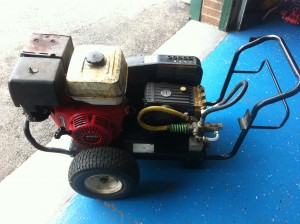
  • Used belt drive pressure washer for sale

    Used belt drive pressure washer with a 30 day warranty
    Used belt drive pressure washer

    This used belt drive pressure washer is for sale at Sun Brite Supply in Maryland.  All of our used pressure washers have been inspected and certified by Sun Brite Supply In Maryland to ensure that the engines are in good running condition.

    We also inspect every pump that comes on our used pressure washers to ensure that the pumps valves, pistons and seals are also in good working mechanical condition and that the pressure washer is putting out the correct water volume and pressure.

    The specifications on these used belt drive pressure washers are:  3,500PSI and 4GPM


    Are You Looking For A Used Belt Drive Pressure Washer

    With Sun Brite Supply in Maryland you have several choices to meet your companies budget with a new or used pressure washer that will handle the type of pressure washing that you do.

    Choosing a used belt drive pressure washer

    Are you a new pressure washing company that is just looking for a lower priced machine to get you by until your ready to invest in new equipment?  If so one of these machines would be perfect for you.

    Are you an established company that is looking for a backup machine, or a machine that you can use for an additional crew to cut down the time on your jobs? These used belt drive pressure washers are perfect until your ready to buy a new pressure washer like one of our Black Knight Belt Drive Pressure Washers!

    Our new Black Knight belt drive pressure washers are built contractor tough with General Pumps and GX Honda Engines to give you the best value around.  Our Black Knights also come with an upgraded unloader system, 50′ of non marking hose, an easy pull trigger gun, tips, an hour meter and heavy duty tires to support the heavy duty aluminum frames.

    How would you like to double your water volume and cut your time on jobs in half?  Use our special dual machine hookup system and combine the water volume from two machines to DOUBLE your water volume!


  • Thank You

    Thank you for taking the time to let us know how we are doing! Just click on one of the images below to leave us a review!

    Like Us Or Post About Us On FaceBook!
    Like Us Or Post About Us On FaceBook!
    Tweet About Us!
    Tweet About Us!
    Vote For Us On Google Places!
    Vote For Us On Google Places!

    Review Us On Insider Pages

    Review Us On Yelp!


    Print Out Your Reviews Every Time You Write One And Bring Them In To Our Store For A Free Gift!

  • Pressure washing classes at Sun Brite Supply In Maryland

    Pressure washing classes reviews


    Have you signed up for a pressure washing class, or training seminar at Sun Brite Supply in Maryland?  Take this 5 question survey to rate the pressure washing class, and tell us what type of classes you would like us to tell you about in the future!


    [wp-simple-survey-1]


    Sun Brite Supply in Maryland hosts and recommends pressure washing classes to help new and veteran pressure washing contractors learn new skills and services that they can offer their clients.  All of our pressure washing classes are based on industry standards and the experiences of the instructors.  All of our pressure washing classes are taught by instructors with experience in the field as a contractor, they understand exactly what you deal with in the field every day, and in the office.  On occasion, Sun Brite Supply offers pressure washing classes in their stores to help their customers succeed, and to ensure that the contractors that take our pressure washing classes is using the most effective and safe methods to clean.  All of our pressure washing classes are based on a philosophy of using the least amount of pressure and cleaners possible to get the surface clean with the least amount of expense in labor, cleaners and time.

    Our Pressure Washing Classes Are Taught By Contractors For Contractors.

    pressure washing classes and seminars

    Most pressure washing classes and materials found online are usually basic information gathered together by someone with very little experience in the field, or in running a successful business, they just use pressure washing classes as a means to make some extra cash.  Usually the material given is more of a home study course, instead of recognized industry standard pressure washing classes.  The other types of pressure washing classes we have seen are based on a get rich quick theme that offers very little content or value.  If you have been in business for even 30 day’s you already know that there isn’t any pressure washing classes that will teach you to become rich overnight!  Running a pressure washing business takes a lot of hard work and time in the beginning, but it is possible to make a very good living from pressure washing if  you know how.   That’s why our pressure washing classes are based on showing you the most profitable methods of running a pressure washing company, and avoiding common mistakes that put other pressure washing companies out of business.

    Our Pressure Washing Classes Can Help You Become More Successful

    The average one man pressure washing company usually earns just under $100,000 a year after they have been in business a few years. To push past that $100,000 barrier you need to have employees, training and a plan to take  your pressure washing business to the next level, and our pressure washing classes can help you get there in less time!

  • Small Engine Repairs

    Need small engine repairs in Maryland?

    Here is a maintenance list for small engines to reduce the risk of small engine repairs:

    • Replace oil
    • Inspect the air filter (and fuel filter if present). If dirty or clogged, clean or replace as appropriate.
    • Remove and inspect the spark plug.

    Reduce small engine repairs with maintenance!


    Checking the oil

    Small Engine Repairs
    Small Engine Repairs for Hot and Cold Water Pressure Washers

    Proper oil level is essential for the mechanics in the engine helping to reduce small engine repairs. Inadequate and it also may overheat causing engine parts to seize and fail and costly small engine repairs. Make it a habit to check the oil regularly. An average small engine in reasonably sound condition doesn’t consume lots of oil but checking oil is mandatory. Oil must be checked once the engine is cold or after waiting ten minutes with this particular engine to empty into the oil sump after running the engine. Put the machine on a flat area. If there’s a dipstick – take it off, wipe it obtaining a rag, and reinsert it directed in regards to the information sticker or in regards to the stick itself – usually threaded fully in place and removed to find out. When the level is low, progressively add the new oil to just below the entire mark.  If under 1/4″ roughly below the lip, add new oil. If oil level is high drain enough oil to lower again to the full mark.  Check oil regularly to reduce small engine repairs.

    Oil change

    Proper oil changes need to be performed at the recommended intervals to reduce small engine repairs.  For small engines, the oil change interval is generally specified by the manufacturer of the machine. More frequent oil changes might be desirable when the items are operated in a very dusty atmosphere. We also suggest an oil change at the end of the season to stop old contaminated oil from sitting in the crankcase over the winter, which may cause small engine repairs.

    Troubleshooting Guide for Small Engine Repairs

    Instant troubleshooting chart – most typical problems and possible causes for small engine repairs:

    Problem: Engine won’t start or is tough to start.

    Possible causes for these small engine repairs:

    • Gas tank is empty or shutoff valve is closed, or fuel line or gas tank cap vent is clogged.
    • There’s water within the fuel.
    • Carburetor is completely clogged.
    • Carburetor is incorrectly modified or needs service.
    • Ignition system or its wiring is defective or ignition switch is off, or timing way off (e.g., damaged flywheel key).
    • Cutoff switch is open or defective.
    • Spark plug is fouled, incorrectly gapped, or broken.
    • Engine compression is poor.
    • Operator must read user manual.

    Problem: Engine begins easily but dies in seconds.

    Possible causes for these small engine repairs:

    • Gas tank is empty or shutoff valve is closed, or fuel line or gas tank cap vent is clogged.
    • Carburetor is completed clogged.
    • Carburetor is incorrectly modified or needs service.

    Problem: Engine idles roughly, unevenly, or surges.

    Possible causes for these small engine repairs:

    • Carburetor is dirty.
    • Air leak in carburetor or intake manifold (e.g., bad O-ring, gasket, primer).
    • Carburetor is incorrectly modified or needs service.

    Problem: Engine misses under load.

    Possible causes for these small engine repairs:

    • Spark plug is fouled, incorrectly gapped, or broken.
    • Breaker points are pitted or incorrectly gapped, breaker arm is sluggish, or condenser is harmful.
    • Carburetor needs adjustment or service.
    • Fuel line, fuel filter, or gas tank cap vent is clogged, or fuel shutoff valve partly closed.
    • Valves not modified correctly or valve springs weak.
    • Exhaust ports blocked (2 stroke).

    Problem: Engine knocks.

    Possible causes for these small engine repairs:

    • Magneto isn’t timed correctly.
    • Carburetor is situated too lean.
    • Engine has overheated.
    • Carbon buildup in combustion chamber.
    • Flywheel is loose.
    • Cylinder is excessively worn.

    Problem: Engine vibrates excessively.

    Possible causes for these small engine repairs:

    • Engine isn’t mounted safely.
    • Engine or other driven items are unbalanced.
    • Crankshaft is bent.
    • Counterbalance shaft isn’t timed properly.

    Problem: Engine lacks energy (possibly after warm-up).

    Possible causes for these small engine repairs:

    • Old gas, bad spark plug, very thick/dirty oil.
    • Choke is partly closed.
    • Carburetor needs adjustment or service.
    • Ignition not timed properly.
    • Air filter is clogged.
    • There’s inefficiencies in lube.
    • Valves aren’t sealing correctly.
    • Piston rings aren’t sealing correctly.
    • Mind loose or mind gasket blown or broken.
    • Exhaust ports blocked (2 stroke).

    Problem: Engine works every once in awhile, surges, and runs unevenly.

    Possible causes for these small engine repairs:

    • Fuel line or gas tank cap vent is clogged.
    • There’s water within the fuel.
    • Fuel pump is defective.
    • Governor isn’t set correctly, adhering, or binding.
    • Carburetor needs adjustment or service.
    • Loose carburetor/intake pipe leading to vacuum leak.

    Problem: Engine getting too hot.

    Possible causes for these small engine repairs:

    • Magneto isn’t timed correctly.
    • Carburetor set too lean.
    • Air intake or cooling fans are clogged.
    • Shroud or blower housing missing.
    • Excessive load.
    • Inadequate or excessive oil.
    • Improper oil viscosity (4 stroke) or mixture (2 stroke)
    • Valve clearance is simply too small.
    • Excessive carbon buildup in combustion chamber.

    Problem: Crankcase breather passing oil.

    Possible causes for these small engine repairs:

    • Lots of oil in crankcase.
    • Engine speed is excessive.
    • Oil fill cap or gasket is broken or missing.
    • Breather mechanism is dirty or defective.
    • Piston ring gaps are aligned.
    • Piston rings are worn.

    Problem: Engine backfires.

    Possible causes for these small engine repairs:

    • Carburetor set too lean.
    • Magneto isn’t timed properly.
    • Valves are adhering.

    For Small Engine Repairs in Montgomery County Maryland, contact Sun Brite Supply of Maryland!

  • Can we help you with something?

    If you have a question about a pressure washing job, a pressure washer problem or anything else related to pressure washing just ask us!

  • Certified Used Pressure Washers And Pressure Washing Equipment In Maryland

    Get Used pressure washers and other pressure washing equipment that has been “Certified By Sun Brite Supply in Maryland” and avoid paying too much, or getting ripped off on bad equipment!

    Buy And Sell Used Pressure Washers And Equipment From Sun Brite Supply Of Maryland!

    Get Great Deals On Sun Brite Supply Of Maryland Certified Used Equipment!

    Have a Sun Brite Supply Mechanic Check Out Any Equipment Before You Buy It To Protect Yourself!

    Get A 60 Day “Half Price” Discount On Any Unexpected Repairs (Parts Not Included)

    If Your Planning On Selling Your Used Pressure Washing Equipment, Leave It To The Experts At Sun Brite Supply In Maryland!

    Avoid Cancelled Payments And Junk Equipment Scams!


    Pressure washing contractors from all over the DC Metro area buy pressure washers from Sun Brite Supply in Maryland, and a lot of them ask us to help them sell their used pressure washers when they upgrade to new equipment. We also have used pressure washing equipment that have been rebuilt and checked out by our pressure washer repair technicians for resale. Some of the used pressure washers we have for sale have had the engines or pumps replaced for a working component that is in good working condition, and some of it is just abandoned pressure washing equipment. No matter where it came from or what condition it was in when we got it, you don’t have to worry about our used pressure washers. Because all of our used pressure washers have been inspected and certified by our repair department before being offered for sale, and all of these used pressure washers come with a 30 day labor warranty.

    Are you trying to sell or buy used pressure washers?

    Sun Brite Supply in Maryland sells used pressure washers from contractors that have moved on to new pressure washing equipment or just want to empty out their garages of used pressure washers and equipment that they no longer use. If you have used pressure washers or pressure washing equipment that you don’t want to keep you can sell them through Sun Brite Supply on consignment.

    Buying used pressure washers and other pressure washing equipment?

    Sun Brite Supply in Maryland can inspect used pressure washers and pressure washing equipment to check it’s value and condition. Don’t buy used power washers or equipment without having it looked at by one of our technicians, or you could end up wasting a lot of money on worthless junk! If you have a used pressure washers that you would like us to inspect, just bring it in to our store or give us a call at 301-519-9274 to set up an appointment to have one of our pressure washer repair mechanics inspect any used pressure washers before you buy them!

    Buying used pressure washersUsed pressure washers can usually be picked up for a great price but are they worth the money?  It’s difficult to say if you don’t understand the basic principles and mechanical functions of pressure washers.  A lot of the problems with used pressure washers come down to insufficient water flow to the pump, or no oil in the engine.  This could be caused by a blocked screen or filter, a crimped hose or something major because pumps on pressure washers are water cooled and excessive heat can damage them quickly.  A lot of the used pressure washers that contractors bring in have been damaged from abuse like this.

  • House Washing Problems

    House washing problems seem to pop up when you least expect them, here are some common problems most power washing companies have on house washing jobs.  Most of the house washing problems we hear about are usually due to not having the proper equipment or the right house washing chemicals for the job.  We suggest using cleaning chemicals that were designed to properly clean the siding.  Some contractors buy a house wash that’s available in most hardware stores and are unable to achieve the results they were expecting. Most of the house washing chemicals contractors use are designed to clean more effectively and give better results.

    Common House Washing Methods


    House Washing Problems? House washing chemicals applied with an XJet really do the job!Most power washing contractors believe that the best way to perform house washing is by using an X-Jet, this tool can cut your cleaning time by 50% or more! if you don’t have one then use a power washer that has a chemical injector built into the machine.  Using a chemical injector for cleaning will allow you to pull the soap from the container, mixing it in the machine with water and spray it onto the house using low pressure starting from the bottom up.

    No matter what method you use for power washing houses, always allow the chemical to dwell on the siding, then using low pressure, rinse the product from the siding. Make sure when your rinsing the product off the siding that you start at one end of the siding all the way to the end. Do not stop or vary your distance from the siding, or it will cause the surface to be cleaned unevenly.


    Common mistakes during house washing made by homeowners and new contractors are:

    Make sure when using a power washer that you don’t shoot water or chemicals up under the siding, this can cause significant mold problems behind your siding.

    Trying to remove the powdery coating called oxidation on aluminum siding when washing a house. Removing this coating can cause discoloration and in some cases cause the siding to look like a completely different color.

    Using too much pressure when performing cleaning can also force water up behind the siding where it will cause mildew behind the siding or in some cases, blow the siding off the house!

    Washing houses from the top down or letting chemicals dry on the house, which may leave streaks on the siding.

    Using a ladder when cleaning to clean the upper areas can result in serious injuries and death from slipping off the ladder.

    These are the types of mishaps that many people have when performing house washing of their home. If you decide to use a power washer on your home, here are some general guidelines to use.

    Make sure the machine your using puts out a minimum of 4 gallons of water per minute and less than 1000 PSI.

    Most homeowners and start up power washing companies will buy a machine from a hardware store that puts out 1,000 PSI but only uses 2 gallons per minute of water. While this machine may work, it will triple the amount of time to do the job properly.

    Be careful if your making your own chemicals. For example, mixing bleach and ammonia can create a poisonous gas.

    Other house washing problems

    If you have dealt with other problems on house washing jobs, or other power washing jobs, share your problem or experience here so we can help you find a solution to the problem.

  • Fleet Washing Chemicals MD

    Fleet Washing chemicals From Sun Brite Supply


    Truck Washing And Fleet washing ChemicalsWe carry fleet washing chemicals for contractors that are deciding to venture further into fleet washing. The work is steady,year-round, and it pays pretty well in high volume. Like any discipline, there are things to know before you start that will help you get off on the right foot. Besides buying a nice soft bristle brush, there are several things you need to think about before you venture into a business like fleet washing.

    We carry a number of different fleet washing chemicals and types of washing methods for vehicles. Everyone knows how to pull out a bucket and a sponge and some soap to wash the family car and then rinse it with the hose. While that works fine on Saturday morning on your Saturn, it is probably not the most efficient method you could choose for finishing 50 trucks.

    One well-known professional method is called “two-stepping”. In this technique, you hit the dirty surface with an acid-based fleet washing chemicals and then finish with an alkaline neutralizer. By switching between the opposite ends of the pH spectrum, the dirt is “popped” off the surface. These acid based fleet washing chemicals are used for the first part of the process is usually made with hydrofluoric acid. One of our hydrofluoric-based fleet washing chemicals is called Aluma Brite. This very aggressive fleet washing chemicals are perfect for any type of truck or fleet washing and for washing aluminum surfaces.


    Most fleet washing chemicals use Hydrofluoric acid

    Hydrofluoric acid is extremely dangerous for inexperienced people to use, however. It travels through the skin to seek and destroy the calcium in your bones and body. Severe exposure to hydrofluoric acid can be fatal in a matter of hours.

    Since so many fleet washers rely on the two – step method for fast, effective results, Sun Brite Supply developed a Safety Ointment for emergency use after exposure to hydrofluoric. It can add several hours of time for you to get medical attention. We offer this with every purchase of our hydrofluoric fleet washing chemicals.

    We also offer alternatives to hydrofluoric- based fleet washing chemicals, for those who are willing to sacrifice some of the aggressiveness of hydrofluoric for the safety of a different acid. We offer a citric/phosphoric solution called Aluma Safe that we sell all over the country to fleet washing companies. Because our have been specially tested and designed for fleet washing contractors, these  products are made to remove the toughest stains and soil from any type of fleet or construction equipment.

    My personal favorite fleet washing chemicals are Big Truck Brite & Fleet Brite.

    This fleet washing chemical is less aggressive than Fleet Brite, but it can be used on all surfaces and it leaves the vehicle with a near-wax shine. I use it on my own truck, and those of you who know how I feel about my truck will understand exactly what that means. By the way, we have Wet Wax that you can add to any fleet washing chemical to get that shine on the vehicle that fleet managers are looking for. (NOTE: We have lots of customers who even buy Wet Wax and add it to house wash mixtures for a nice gleam on vinyl and aluminum!)

    Besides all of these concentrated fleet washing chemicals, we offer a powdered product called Pearl Sheen. This product is relatively new to our stable from the folks at Extreme Solutions (the HD-80 people). We know that some of you prefer powders and some prefer liquids, so we decided to carry both.

    Most fleet washing chemicals work better with hot water than cold. If you don’t have a hot water pressure washer, you will use about twice the amount of fleet washing chemicals to get the job done. It’s pretty tough to wash fleets in January in Alaska if you don’t have hot water, too. There are alternatives to buying a new hot water pressure washer if you don’t already have one, though. Sun Brite Supply has Hot Boxes, which are heaters designed to connect to cold water machines.

    The water you use for fleet washing makes a big difference, too. Many cleaners like to use de- ionized water (D. I. for short). This water goes through a treatment that makes it rinse off the vehicle without spots. A good wash rinse is the key to getting the most professional results. If you don’t have a D. I. system, there are some easy alternatives to D. I. that are extremely inexpensive. We have a product call SoSoft, for example, that costs only pennies to use and is almost as effective as using D. I. with your fleet washing chemicals, you just add it to your water to end up with a spot-free rinse.