
Collection: Giant Pumps
Giant Pumps
-
P317rx 3.7GPM 3000PSI ...
Regular price $691.99Regular priceper -
P316RX 3.9GPM 3000PSI ...
Regular price $691.99Regular priceper


Giant Pumps
Giant Industries has been building triplex plunger pumps in the USA for decades, and contractors who run them tend to buy them again. This collection covers Giant pressure washer pumps from 2.5 GPM utility models up to 9.9 GPM commercial units, plus the valve kits and packing kits that keep them alive. Need help matching a Giant pump to your engine or motor? Call 301-519-9274 and we will spec it before you order.
Choosing a Giant Pressure Washer Pump
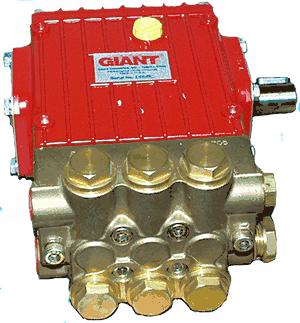
Giant builds these pumps around solid ceramic plungers, stainless steel valves, and a forged brass manifold on an aluminum crankcase. That recipe is why a properly oiled Giant pump routinely outlives the engine bolted next to it. Your job is picking the right frame and the right speed. Get those two right and the rest is plumbing.
Understand the Series Numbers
The model number tells you the frame size. P200 series pumps are the compact workhorses, around 3.3 to 4.2 GPM, sized for typical contractor rigs. P300 series pumps carry a heavier frame and cover the most popular pressure washing range, roughly 3.7 to 5.8 GPM at up to 3,200 PSI. P400 series pumps are the big-flow units, 9.9 GPM and beyond on a 28mm shaft, built for multi-gun trailers and industrial skids. The W-series models like the P56W come from the carwash world and run all day at moderate pressure. Across the full Giant line you will find flows from under 1 GPM to over 18 GPM, so there is a frame for almost any duty.
Match the RPM to Your Drive
The same Giant pump often comes in two or three speed versions, and this is where buyers get burned. A 3450 RPM version bolts to a gas engine for direct drive. The 1450 to 1800 RPM versions are meant for belt drive, gearbox drive, or 4-pole electric motors. Slower crankshaft speed means less heat and less packing wear, which is why the low-RPM versions dominate commercial rigs. Buy the RPM that matches your drive, not the one that ships first. A 1450 RPM pump spun at 3450 will not survive, and a 3450 RPM pump spun at 1450 delivers about 40% of its rated flow.
Giant Pump Lineup
| Model | GPM | PSI | RPM | Shaft | Price |
|---|---|---|---|---|---|
| GXH2525A-112H | 2.5 | 2,500 | 3,450 | 7/8" hollow | $383.95 |
| P217RX | 3.3 | 2,000 | 3,450 | 24mm | $555.00 |
| P218RX | 3.4 | 2,000 | 1,750 | 24mm | $555.00 |
| P219RX | 4.2 | 2,500 | 1,750 | 24mm | $555.00 |
| P321R | 3.8 | 3,200 | 3,450 | 24mm | $585.00 |
| P318R | 5.8 | 1,000 | 1,750 | 24mm | $690.00 |
| P316RX | 3.9 | 3,000 | 1,450 | 24mm | $691.99 |
| P317RX | 3.7 | 3,000 | 1,800 | 24mm | $691.99 |
| P56W | 6.1 | 1,900 | 1,420 | 24mm | $1,723.80 |
| P422R | 9.9 | 2,600 | 1,450 | 28mm | $1,779.43 |
The P316RX and P317RX are the two we keep on the shelf in Gaithersburg because they fit the most common 4 GPM belt and gear drive rigs. The rest of the line is available to order, and lead times are usually short. Call before you drive over.

Keep It Alive: Kits Instead of Replacements
Every Giant pump here is fully rebuildable, which is half the argument for buying one. When pressure drops or the oil turns milky, the fix is usually a kit, not a new pump. We carry plunger packing kits for the P316, P317, and P319, check valve kits for P200 and P300 pumps, and oil seal kits that cost less than a tank of gas. Watch the weep holes under the manifold. A slow drip there means the packings are going, and changing them early protects the plungers, which are the expensive part.
From the Field
Giant pumps that come across our counter for rebuilds almost always died the same two ways. First, cavitation from a starved inlet. A 4 GPM pump needs a real water supply, and running it off a half-clogged filter chews up packings in a season. Second, heat from long bypass. If your crew leaves the gun closed while they move ladders, the water in that brass head climbs past the 160 degree limit fast. A cheap thermal relief valve dumps hot water and saves a four hundred dollar rebuild. Both failures are preventable for under twenty bucks, which is the cheapest insurance in this catalog.
Related Collections
- Giant pump parts
- All pressure washer pumps
- General Pumps
- CAT Pumps
- AR Pumps
- Comet Pumps
- Udor Pumps
- Unloader valves
- Thermal relief valves
- Pump oils
Rather see the pump before you buy? Our Gaithersburg store is open to walk-ins.
Frequently Asked Questions
Are Giant pumps any good?
Yes. Giant Industries builds triplex pumps with ceramic plungers, stainless valves, and forged brass manifolds, and they are fully rebuildable. Contractors run them for years on nothing but oil changes and packing kits.
Which Giant pump series should I buy?
P200 series for compact 3 to 4 GPM rigs, P300 series for the classic 4 GPM contractor setup at 3,000 PSI, and P400 series when you need 9 GPM or more for multi-gun work. When in doubt, size the pump to your engine horsepower and call us to confirm.
Why does the same pump come in different RPM versions?
Drive type. 3450 RPM versions bolt straight to gas engines. 1450 to 1800 RPM versions are for belt drives, gearboxes, and 4-pole electric motors. The slow versions run cooler and last longer, but only if your drive actually turns them at that speed.
Can I rebuild a Giant pump myself?
Most people can. Packing kits and valve kits install with basic hand tools, and the pump head comes off with a few bolts. Match the kit to your plunger size, 18mm on P217 through P219 for example, and take photos as you disassemble.
What oil does a Giant pump use and how often?
Non-detergent pump crankcase oil, changed after the first 50 hours and every 250 to 500 hours after, or sooner if it looks milky. Milky oil means water is getting past the seals and an oil seal kit should go in soon.
Will a Giant pump fit my existing machine?
If your current pump has a 24mm solid shaft, most P200 and P300 models drop in. Bolt patterns and pulley bores still deserve a check. Send us a photo of your setup and the model number of the old pump and we will confirm fit.