
Collection: Hose Fittings
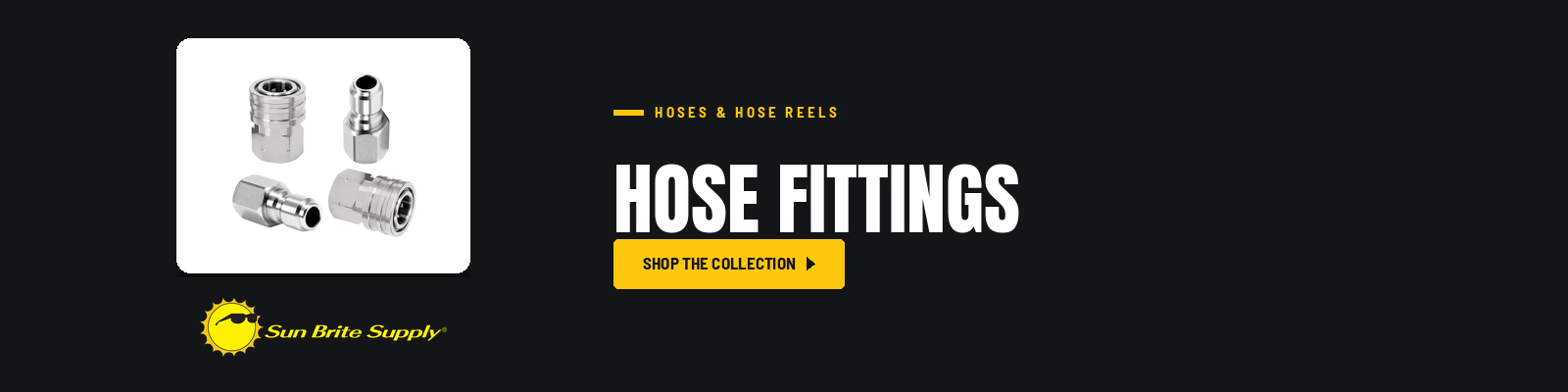
Hose Fittings
-
Box of 10 S.s. #10 Hos...
Regular price From $16.82Regular priceper -
Box of 10 S.s. #4 Micr...
Regular price From $12.44Regular priceper


Pressure Washer Hose Fittings
A high pressure hose is only as good as the metal on each end of it. Sun Brite Supply stocks pressure washer hose fittings in Gaithersburg, MD, from crimp-on hose ends and swivels to the clamps, bend restrictors, and hardware that keep a 4,000 PSI line alive season after season. Bring the hose to our counter or call 301-519-9274 and we will match the ends for you before you buy the wrong thread twice.
Match the Thread Before You Buy Anything
Almost every fitting return we process comes down to thread confusion, so start here. Contractor-grade machines and hoses in this country run on NPT pipe thread, usually 3/8 inch on the hose and gun, sometimes 1/4 inch on smaller machines. NPT is tapered and seals on the threads, so male ends get PTFE tape or liquid sealant. Homeowner-grade electric machines mostly use M22 metric screw couplings instead, and M22 comes in two versions that do not mix. Gas machines use M22 with a 14mm inner diameter, most electrics use 15mm. They look identical from arm's length and they will not seal against each other.
Material matters as much as thread. Plated steel and brass handle everyday cold water work up to roughly 4,000 PSI depending on size. Stainless costs more and shrugs off chemicals, hot water, and rust, which is why soft wash and fleet crews standardize on it. Plastic has no business anywhere on the high pressure side.
Crimp-On Hose Ends: Solid vs Swivel
The fittings crimped onto each end of a pressure hose are not decorations, they are the part that actually holds back the pressure. We sell installed crimp fittings in 1/4, 3/8, and 1/2 inch MPT, in solid and swivel styles, and we crimp them onto hose here in the shop. The usual setup puts a solid end at the machine and a swivel end at the gun. The swivel nut spins independently, so the hose stops fighting you every time you loop it over your shoulder or coil it on the reel. If your current hose twists itself into figure eights all day, the fix costs about eleven dollars.

The Hardware That Saves Hoses
Most hoses do not blow out in the middle. They fail right behind the fitting, where the hose flexes hardest against a rigid end. A bend restrictor is a spring or sleeve that spreads that flex over several inches instead of one point, and at around five dollars it is the cheapest way to double the life of a 3/8 inch line. Stainless worm-gear clamps handle the low pressure side, supply lines, chemical lines, and bypass hoses. Clamp sizes run by number, #4 and #6 micro clamps for 1/4 inch chemical tubing up through #20 and #24 for larger supply hose. For 1/2 inch ID hose under real vibration, a two-bolt Boss clamp grips harder than any worm gear will. Cable ties finish the job by keeping bundled lines from sawing against the frame.
Hose End and Hardware Lookup
| Problem | Part | Price |
|---|---|---|
| Hose kinks right behind the gun fitting | Bend Restrictor for 3/8" Whitewater Hose | $5.42 |
| Need a fixed 1/2" machine-end hose fitting | Installed 1/2 MPT Solid Crimp Fitting | $6.00 |
| Need a fixed 3/8" machine-end hose fitting | Installed 3/8 MPT Solid Crimp Fitting | $6.00 |
| Hose twists while you work, 1/2" line | Installed 1/2 MPT Swivel Crimp Fitting | $11.12 |
| Hose twists while you work, 3/8" line | Installed 3/8 MPT Swivel Crimp Fitting | $15.13 |
| Small machine, 1/4" gun-end swivel | Installed 1/4 MPT Swivel Crimp Fitting | $16.23 |
| Chemical tubing slips off its barb | #4 Micro Stainless Clamps, Box of 10 | $12.44 |
| 1/2" ID hose under heavy vibration | Boss 2-Bolt Clamp for 1/2" ID Hose | $11.30 |
| Loose lines chafing on the rig | Cable Ties, 100 Pack | $4.15 |
Prices move with metal markets. Call before you drive if you need a specific size today.

From the Field
Look at what wears out and you learn where rigs actually fail. We sell swivel crimp ends at several times the rate of solid ones, almost always to someone replacing a gun-end fitting that seized up after a year of grit and no grease. A shot of lithium grease under the swivel collar twice a season prevents that. The clamp boxes go out the door to trailer builders who learned the hard way that a single loose chemical line can drain a jug of surfactant across a customer's driveway. And bend restrictors are the part people buy on the second hose, never the first, because nobody believes a hose fails at the fitting until they have watched one do it.
Related Collections
- All Fittings
- Quick Connects
- Adapters
- Swivels
- Hose Barbs
- Brass Pipe Fittings
- Stainless Steel Pipe Fittings
- Whip Lines
- Hose Reels
- Stop by our Gaithersburg store and we will crimp ends while you wait
Frequently Asked Questions
What thread do pressure washer hoses use?
Commercial machines and replacement hoses in the US run on NPT pipe thread, most often 3/8 inch with 1/4 inch on smaller units. Homeowner electric machines usually use M22 screw couplings. Check your gun and machine ends before ordering, since the two systems only connect through an adapter.
What is the difference between M22 14mm and M22 15mm?
Both use the same 22mm outer thread, but the sealing post inside differs. Gas machines run 14mm and most electrics run 15mm. Mixing them gives you a connection that threads on fine and leaks anyway. Measure the inner hole or bring the fitting in.
Can a crimped hose fitting be replaced?
Yes, if the hose itself is still sound. We cut the damaged end back and crimp a new solid or swivel fitting on at our Gaithersburg counter. On an expensive 100 foot hose, a new end costs a fraction of a new line.
Should I get a solid or swivel hose end?
Solid at the machine, swivel at the gun. The swivel lets the hose rotate as you move so it does not twist into coils while you work. If you drag hose all day, the swivel end is not optional.
Why do hoses always fail near the fitting?
The crimped end cannot flex and the hose can, so all the bending concentrates in the first few inches behind the fitting. A bend restrictor spreads that stress out. Fit one on the gun end of every new hose and the ends stop being the weak point.
What size hose clamp do I need?
Clamp numbers follow diameter. #4 and #6 micro clamps fit 1/4 inch chemical tubing, #8 through #12 cover common supply hose, and #20 or #24 handle larger inlet plumbing. For 1/2 inch ID hose on a vibrating rig, step up to a two-bolt Boss clamp.