

12.5% Sodium Hypochlorite (SH) Pressure Washing Bleach
12.5% Sodium Hypochlorite (SH) Pressure Washing Bleach
- Order Policies
- Item# 99994
Call 301-519-9274 and we will have your order ready.
Couldn't load pickup availability
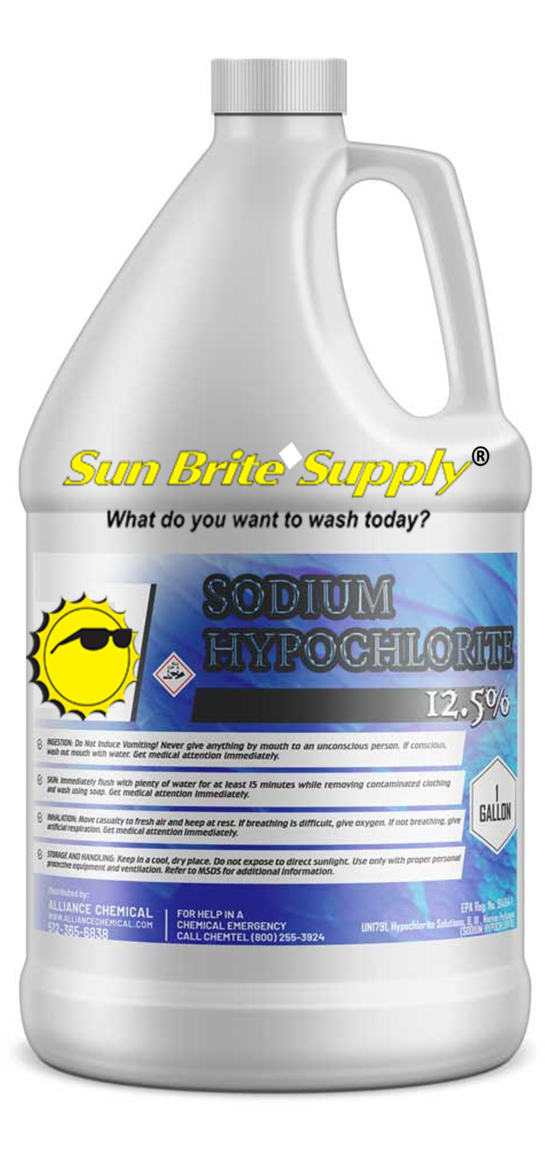
12.5% Sodium Hypochlorite (SH) for Pressure Washing and Soft Washing
LOCAL PICKUP ONLY from our Gaithersburg, Maryland warehouse. We do not ship sodium hypochlorite.
Sodium hypochlorite at 12.5% concentration is the single most important chemical in a pressure washing contractor's arsenal. If you wash houses, clean roofs, treat concrete, or do any kind of exterior cleaning that involves organic growth, SH is what actually does the killing. The pressure washer removes the dead material. The chemical does the real work.
Every working contractor in the mid-Atlantic region goes through gallons of this stuff every week. We keep it fresh and stocked at our warehouse because SH loses strength over time, especially in heat. Buying from a local supplier like Sun Brite means you are getting product that has not been sitting in a hot warehouse for months slowly degrading. Fresh SH cleans better and goes further.
What Is Sodium Hypochlorite?
Sodium hypochlorite (chemical formula NaOCl) is the active ingredient in bleach. At 12.5% concentration, it is roughly 2.5 times stronger than the household bleach you buy at the grocery store (which runs about 5 to 6 percent). Professional-grade 12.5% SH is what the pressure washing industry uses because it can be diluted down to the right strength for any job while still being effective.
SH works by oxidation. The hypochlorite ion penetrates organic material (algae, mold, mildew, lichen, moss, bacteria) and destroys it at the cellular level. This is why soft washing with SH produces results that last 12 to 18 months or longer. You are not just blasting the growth off with water pressure. You are killing it chemically so it takes much longer to come back.
Product Specifications
| Spec | Detail |
|---|---|
| Active Ingredient | Sodium Hypochlorite (NaOCl) |
| Concentration | 12.5% (trade grade) |
| Equivalent Bleach Strength | ~2.5x household bleach |
| pH | ~12.5 (highly alkaline) |
| Appearance | Clear to slightly yellow liquid |
| Odor | Strong chlorine smell |
| Container Size | Sold by the gallon |
| Shelf Life | 30 to 90 days at full strength (temperature dependent) |
| Availability | Local pickup only, Gaithersburg, MD |
| Hazmat Classification | Corrosive, Class 8 |
Dilution Guide for Pressure Washing
You never apply 12.5% SH at full strength on a job. It gets diluted based on the surface you are cleaning and the application method. Here are the most common dilution ratios contractors use:
Want exact gallons for your batch? Use our free SH Mix Calculator. Enter your real SH strength, target percentage, batch size, machine GPM, hose length, and injector size, and it gives you gallons of bleach, gallons of water, and surfactant ounces.
Downstream Injector (Low Pressure Application)
Most downstream injectors pull chemical at roughly a 10:1 ratio (10 parts water to 1 part chemical). That means your bucket mix gets diluted again before it hits the surface. Here is a rough guide:
| Surface | Bucket Mix | Approximate Strength on Surface |
|---|---|---|
| Vinyl Siding (light growth) | 1 part SH to 4 parts water | ~0.3% |
| Vinyl Siding (heavy mold) | 1 part SH to 2 parts water | ~0.5% |
| Brick or Stucco | 1 part SH to 2 parts water | ~0.5% |
| Concrete (organic stains) | Straight SH in bucket | ~1.2% |
Soft Wash System (Dedicated Pump)
Soft wash pumps deliver chemical with very little dilution, so you control the strength in your tank mix:
| Surface | Tank Mix Ratio | Approximate Strength Applied |
|---|---|---|
| Asphalt Shingle Roof | 50/50 SH and water | ~6% |
| Heavy Roof (lichen, moss) | 60% SH, 40% water | ~7.5% |
| Vinyl or Hardy Siding | 1 part SH to 3 parts water | ~3% |
| Gutters and Fascia | 1 part SH to 2 parts water | ~4% |
Always add a surfactant to your SH mix. Surfactant helps the solution cling to vertical surfaces and gives it dwell time to work. Without surfactant, the SH runs straight off the surface before it has time to kill anything.
What SH Cleans Best
- House washing. Green and black mold/mildew on vinyl, Hardy board, wood, brick, stucco, and painted surfaces. SH is the industry standard for house washing and nothing else comes close for organic growth.
- Roof cleaning. Black streaks on asphalt shingles (caused by Gloeocapsa magma algae), green algae, lichen, and moss. SH-based soft washing is the only method recommended by shingle manufacturers like GAF and CertainTeed.
- Concrete pre-treatment. Apply SH before surface cleaning driveways, sidewalks, and patios to kill organic growth. The surface cleaner then removes the dead material for a deeper, longer-lasting clean.
- Fence and deck cleaning. Wood and vinyl fences covered in green algae and mildew. SH kills the growth and brightens the surface.
- Dumpster pad cleaning. Kills bacteria and organic growth while deodorizing. Commercial property managers love this service.
Storage and Handling
SH degrades over time, and heat speeds up that process. Here is how to get the most out of every gallon:
- Store in a cool, shaded location. Direct sunlight and temperatures above 80 degrees F accelerate degradation. A garage or covered area of your trailer is ideal.
- Use it within 30 days. Fresh 12.5% SH is at peak strength. After 30 days, it starts dropping. After 90 days in warm conditions, you might be down to 8 or 9 percent.
- Keep containers sealed. Exposure to air also degrades SH. Keep the cap tight when you are not pouring.
- Store away from acids. Never store SH near muriatic acid, oxalic acid, or other acidic products. Mixing chlorine and acid produces toxic chlorine gas.
- Use chemical-resistant containers. SH is corrosive. Store and transport it in polyethylene containers designed for chemical use. Do not use metal containers.
Safety Requirements
Sodium hypochlorite is a corrosive chemical and you need to take it seriously. Required PPE includes:
- Chemical-resistant gloves (nitrile or PVC)
- Safety glasses or goggles
- Long sleeves and pants
- Chemical-resistant boots or shoe covers
- Respirator if applying in enclosed or poorly ventilated areas
Pre-wet all plants, grass, and landscaping before and after applying SH near them. Rinse vegetation thoroughly when the job is done. SH will burn plants if you leave it on them.
Frequently Asked Questions
Is 12.5% sodium hypochlorite the same as pool chlorine?
They are chemically similar but not identical. Pool chlorine (liquid chlorine) is typically 10 to 12.5% sodium hypochlorite. The main difference is that pool-grade SH sometimes has added stabilizers or different pH levels. Trade-grade 12.5% SH sold for pressure washing is the preferred product for cleaning applications.
Can I use regular grocery store bleach instead?
Technically yes, but it is not practical or cost effective. Grocery store bleach is around 5 to 6 percent SH, so you would need to use 2 to 3 times as much to get the same cleaning strength. At contractor volumes, the cost difference is huge. Professional 12.5% SH costs a fraction of what the equivalent amount of retail bleach would cost.
Why do you not ship sodium hypochlorite?
SH is classified as a hazardous material (Class 8, Corrosive) by the DOT. Shipping hazmat requires special packaging, labeling, and carrier certifications that make it extremely expensive for small quantities. Local pickup keeps the price low and ensures you get fresh product.
How much SH do I need for a typical house wash?
A standard 2,000 square foot house typically takes 5 to 10 gallons of 12.5% SH depending on the severity of the growth and your dilution ratio. A heavily contaminated house with thick mold and mildew on all four sides might take 15 gallons. Most contractors buy 15 to 30 gallons at a time to cover a day or two of work.
What surfactant should I add to SH?
Use a surfactant specifically formulated for use with sodium hypochlorite. Standard dish soap and many cleaning products break down in SH and lose their surfactant properties. We carry professional-grade house wash surfactants in our chemicals collection that are designed to work with chlorine-based solutions.
Does SH damage asphalt shingles?
No, when used at the proper dilution and applied at low pressure (soft wash). In fact, the Asphalt Roofing Manufacturers Association (ARMA) specifically recommends a sodium hypochlorite solution for cleaning asphalt shingle roofs. High pressure will damage shingles, but that is a pressure problem, not a chemical problem. Soft washing with SH at 3 to 6 percent is the safest and most effective method.