

Roof And House Wash Cleaning Chemical
Roof And House Wash Cleaning Chemical
- Order Policies
- Item# 94480.1
Couldn't load pickup availability
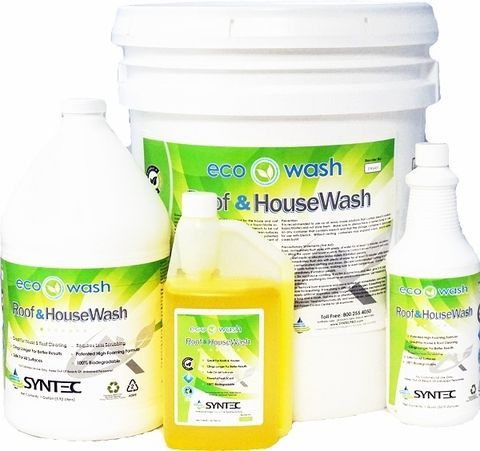
Roof and House Wash Cleaning Chemical for Pressure Washing and Soft Washing
Algae, mold, and mildew do not care whether they are growing on a roof or on siding. They are all the same organisms feeding on moisture and organic debris, and they respond to the same treatment. This roof and house wash chemical is built around sodium hypochlorite, the active ingredient professional pressure washers and soft washers rely on to kill organic growth at the root and rinse it clean.
One product handles both the roof and the house. That matters because most residential exterior cleaning jobs include both. A customer who calls about black streaks on their roof almost always has green or black growth on the siding too. Instead of mixing a separate batch for each surface, you run one formula through your soft wash system and work the entire exterior in a single visit.
Mix rate with sodium hypochlorite: 6 to 8 oz per 5 gallons of finished mix. Roof and House Wash is bleach-stable, so it holds your SH strength in the tank. Use what you mix the same day. Get the exact gallons of SH, water, and ounces of surfactant for any batch with our free SH Mix Calculator.
What This Chemical Does
Sodium hypochlorite based cleaners work differently than detergent-only products. Detergents lift surface dirt. SH kills the organism that is causing the discoloration, algae, mold, mildew, lichen, and the dark staining caused by Gloeocapsa magma on asphalt shingles. The chemical penetrates the growth, breaks it down, and the dead material rinses away with low-pressure water. That is the entire basis of soft washing.
| Surface | What It Treats |
|---|---|
| Asphalt Shingle Roofs | Black streaks (Gloeocapsa magma), moss, lichen, algae |
| Vinyl Siding | Green algae, mildew, general organic film |
| Stucco and EIFS | Black and green organic growth, embedded mildew |
| Brick and Masonry | Algae, moss on mortar joints, organic staining |
| Painted Wood | Surface mildew, organic film |
| Fencing | Green algae, mold on vinyl and wood fences |
| Concrete (supplemental) | Organic staining on flatwork when paired with a surface cleaner |
Specifications
| Spec | Detail |
|---|---|
| Active Ingredient | Sodium hypochlorite (SH) based formula |
| Type | Concentrated cleaning chemical |
| Application Methods | Downstream injector, X-Jet, 12V pump, batch tank, soft wash system |
| Surface Compatibility | Asphalt shingles, vinyl, stucco, EIFS, brick, painted wood |
| Available Sizes | 1 gallon, 4 gallons, 5 gallons |
| Shipping | Hazmat - local pickup available at Gaithersburg, MD warehouse |
| Storage | Cool, shaded location. Heat degrades SH potency quickly. |
How to Use Roof and House Wash Chemical
Roof Soft Washing
Roof cleaning is a low-pressure job. You never blast a roof with a pressure washer wand. The shingles cannot handle it, and you will void the manufacturer's warranty the second you point a high-pressure nozzle at them. Instead, you apply the chemical at low pressure using a soft wash system, 12V pump, or dedicated roof cleaning rig like the Roofster.
The chemical does the work, not the pressure. Apply the roof wash mix to the affected shingles, starting from the bottom and working up to prevent streaking. Let it dwell for 15 to 20 minutes. The SH kills the Gloeocapsa magma and other organisms. Then rinse gently from the top down with low-pressure water. The dead growth washes off and the shingle color comes back.
For heavy growth or thick lichen, you may need a second application. Do not increase the chemical concentration beyond label recommendations. More chemical does not mean faster results; it just means more risk to the landscaping below.
House Washing
For siding, stucco, and other vertical surfaces, apply with a downstream injector, X-Jet, or 12V pump. The application method does not change the chemistry. It just changes how the product gets onto the surface.
Downstream injection is the most common method for house washing. The injector draws the chemical into the water stream on the low-pressure side of your system, and you apply it through a soap nozzle (65 degree black tip) or a J-rod. Let the chemical dwell on the surface for 5 to 10 minutes, then rinse with a standard pressure washer wand from the top down.
Application Best Practices
- Work on an overcast day or early in the morning when possible. Direct sun dries the chemical on the surface too fast, which reduces dwell time and can leave residue marks. If you cannot avoid the sun, keep the surface wet during the dwell period.
- Pre-wet all landscaping, grass, and shrubs. Saturated plants absorb less chemical runoff than dry plants. Wet them down before you start, keep them wet during the job, and rinse them thoroughly after.
- Cover sensitive plants. Some ornamentals and fresh plantings are more vulnerable than mature landscaping. Throw a tarp or plastic sheeting over anything you do not want to risk.
- Follow label dilution ratios. Over-mixing wastes product and increases the risk of surface damage and plant harm. The label ratios are there because they work.
- Do not let the chemical dry on the surface. Dried SH residue leaves white haze marks that require extra work to remove. If the surface starts drying during the dwell time, mist it lightly with water to keep it wet until you rinse.
Roof and House Wash vs. Straight Sodium Hypochlorite
Some contractors buy raw sodium hypochlorite (pool bleach, typically 10 to 12.5%) and mix their own roof wash from scratch. That works, but this pre-formulated product offers some advantages:
- Consistent formulation. Raw SH degrades in storage, and the concentration varies by supplier and age. A formulated product gives you a consistent starting point every time.
- Built-in surfactants. Surfactants help the chemical cling to vertical surfaces and rooflines instead of running off immediately. Raw SH has no surfactant, so it sheets off steep surfaces before it can dwell long enough to work. You can add a separate surfactant to raw SH, but that is one more thing to carry, measure, and mix on site.
- Simplified inventory. One jug replaces a bleach jug plus a surfactant jug plus a measuring setup. Less to carry, less to mix wrong.
Storage and Shelf Life
Sodium hypochlorite breaks down faster than most people realize. Heat and sunlight accelerate the degradation. A jug left in a hot truck bed or in direct sun on the trailer will lose a significant portion of its potency in a matter of weeks.
Store this product in a cool, shaded area. A garage, shed, or covered trailer compartment works fine. Do not stockpile more than you will use in 30 to 60 days, especially during the summer months when heat exposure is highest.
If the chemical smells noticeably weaker than when you bought it or if cleaning performance drops off, the SH has degraded and you need fresh product.
Safety Considerations
- Wear appropriate PPE. Chemical-resistant gloves, safety glasses, and clothing that covers your skin. SH irritates eyes and skin on contact.
- Do not mix with acids. Mixing SH with acidic cleaners produces chlorine gas, which is dangerous to breathe. If the job needs both an SH wash and an acid treatment (like an efflorescence removal), do them as separate steps with a water rinse between.
- Ventilate enclosed areas. Do not apply SH-based chemicals in enclosed spaces or areas with poor air circulation.
- Keep away from metals. SH corrodes non-stainless metals over time. Rinse any metal surfaces (window frames, light fixtures, railings) that get overspray during the application.
Frequently Asked Questions
Will this chemical damage my roof shingles?
No. When used at the recommended dilution and applied at low pressure, sodium hypochlorite based roof wash chemicals are the method recommended by shingle manufacturers like GAF and CertainTeed for removing algae staining. High-pressure washing is what damages shingles, not the chemical.
How many square feet does one gallon cover?
Coverage depends on your dilution ratio and application method. At typical downstream injector dilution, one gallon of concentrate covers approximately 500 to 1,000 square feet of exterior surface. Roof applications at stronger concentrations will cover less area per gallon.
Can I use this through a downstream chemical injector?
Yes. A downstream injector is one of the most common application methods for house washing with this product. The injector draws the chemical into the low-pressure side of your water stream. Use a soap nozzle (65 degree black tip) to maintain the low pressure needed for chemical application.
Is this the same thing as pool bleach?
Pool bleach is pure sodium hypochlorite, usually at 10 to 12.5% concentration. This roof and house wash is an SH-based formula with added surfactants and cleaning agents that improve dwell, surface adhesion, and cleaning performance. It is purpose-built for exterior cleaning, not pool sanitation.
Can I use this product to clean concrete?
It will help with organic staining on concrete (algae, mold, mildew), but it is not a concrete degreaser. For oil and grease stains on concrete, use a dedicated concrete cleaner like our Concrete Cleaner or One Shot Degreaser.
Why is this product local pickup only?
Sodium hypochlorite based chemicals are classified as hazmat for shipping purposes, which adds cost and complexity to delivery. We offer local pickup at our Gaithersburg, Maryland warehouse at 16620 Oakmont Ave. Call us at 301-519-9274 to arrange pickup or discuss shipping options for your area.