
Collection: All Pressure Washers
All Pressure Washers
-
Pressure Pro TRHDCV555...
Call For A Quote (301) 519-9274Sold out -
Pressure Pro TR8012PRO...
Call For A Quote (301) 519-9274Sold out -
Pressure Pro 8GPM 8012...
Call For A Quote (301) 519-9274Sold out -
PressurePro V-Belt Pre...
Call For A Quote (301) 519-9274Sold out -
PressurePro V-Belt Pre...
Call For A Quote (301) 519-9274Sold out -
Phantom Direct PW 4000...
Regular price $1,529.00Regular priceper -
Bandit PW, 4.0/4000, GP
Regular price $1,999.00Regular priceper -
BE 4000/4.0 Cat Aluminum
Regular price $1,759.00Regular priceper -
BE Pressure Washer Equ...
Regular price $2,149.00Regular priceper -
V-Belt 3VX425 for Band...
Regular price $19.91Regular priceper -
Phantom 5.0 Equipment ...
Regular price $2,499.00Regular priceper -
Bandit 5.5 Equipment B...
Regular price $2,899.00Regular priceper -
Phantom Direct-Drive P...
Regular price $1,529.00Regular priceper -
Stationary Hot Box 12V...
Regular price $3,998.35Regular priceper -
BE Pressure Washer 420...
Regular price $1,269.00Regular priceper -
BE Pressure Washer 420...
Regular price $1,499.00Regular priceper -
Phantom Cold Water Pre...
Regular price $1,599.00Regular priceper -
PressurePro Pressure W...
Regular price $1,982.00Regular priceper -
PressurePro Pressure W...
Regular price $1,599.00Regular priceper -
Bandit Pressure Washer...
Regular price $2,099.00Regular priceper -
BE Pressure Washer 420...
Regular price $1,349.00Regular priceper





Professional Pressure Washers
Buying a commercial pressure washer comes down to three choices: how many gallons per minute, cold or hot water, and what it sits on. Everything else is detail. We sell contractor machines from 4 GPM starter units to 8 GPM hot water trailers, and every machine leaves our Gaithersburg shop assembled, oiled, and test fired. Talk through your first or next machine at 301-519-9274 before you spend the money.
How to Size a Commercial Pressure Washer
Start with flow, not pressure. GPM controls how fast you rinse, and rinsing is where the hours go on most jobs. PSI just needs to clear the threshold for the surface: around 2,500 to 3,000 for residential concrete and 3,500 and up for heavy commercial flatwork. Multiply the two and you get cleaning units, so a 4 GPM machine at 4,000 PSI delivers 16,000 CU while a box store 2.3 GPM unit at 3,100 PSI manages about 7,000. That difference is why a pro finishes a driveway in the time a homeowner machine spends on one car pad. If washing pays your bills, 4 GPM is the floor. Crews that quote by the job step up to 5.5 or 8 GPM and finish in half the visits.
What Separates a Contractor Machine From a Box Store Unit
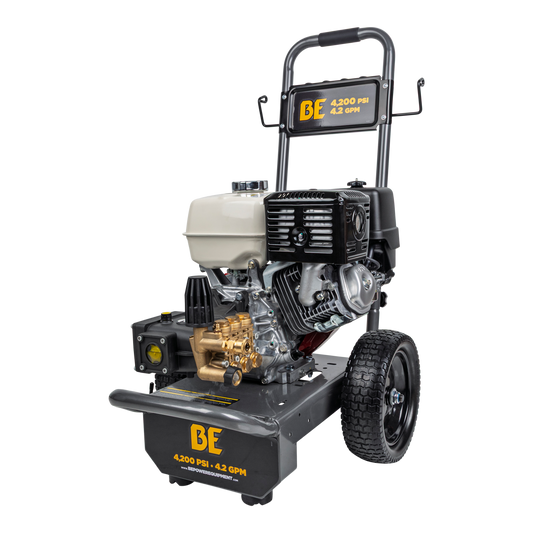
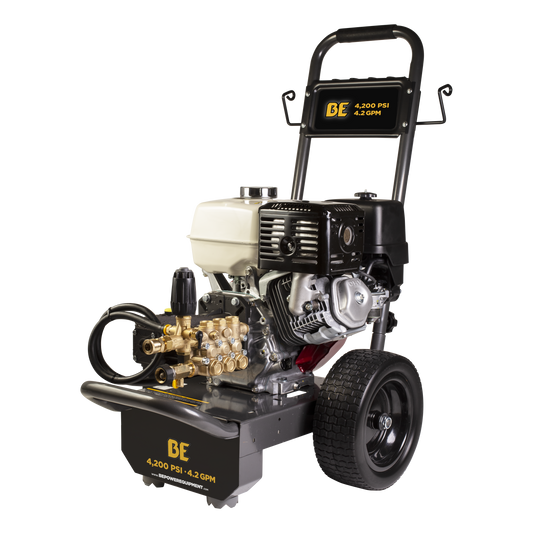
Three things. A triplex plunger pump from General Pump, Comet, AR, or CAT that can be rebuilt with a parts kit instead of thrown away. A Honda GX commercial engine that starts on the first pull in year five. And a frame, unloader, and gun rated for daily hours instead of weekend use. The BE 4200 PSI 4.2 GPM with Honda GX390 shows what that buys at the entry point: real engine, real pump, serviceable everything, for close to what a big box premium unit costs.
Direct Drive, Belt Drive, and When Each Makes Sense
Direct drive machines couple the pump straight to the engine. They cost less, weigh less, and fit tighter truck beds, and they are the right call under about 20 hours of washing a week. Belt drive machines like the Bandit 5.5 GPM spin the pump at less than half the engine speed, which drops heat and stretches pump life by years. Full-time crews buy belt drive once and stop thinking about it. The price gap usually pays for itself before the second season.
Cold Water or Hot Water
Cold water machines handle dirt, algae, mildew, and most residential work when paired with the right chemicals. Hot water changes the game on grease, oil, and gum. Heat cuts petroleum soils that cold water just pushes around, which is why fleet yards, kitchens, and dumpster pads are hot water accounts. The rule of thumb we give buyers: once greasy work makes up about a third of your revenue, the burner pays for itself in chemical savings and job speed. You can also add heat to a cold machine later with a hot box instead of replacing the whole rig.
Current Machines Compared
| Machine | GPM | PSI | Type | Best For | Price |
|---|---|---|---|---|---|
| BE 4200 Honda, AR pump | 4.2 | 4,200 | Direct, cold | First commercial machine | $1,269 |
| BE 4200 Honda, Comet pump | 4.2 | 4,200 | Direct, cold | Step-up pump option | $1,349 |
| Phantom 4000, GP pump | 4.0 | 4,000 | Direct, cold | Residential wash rigs | $1,529 |
| Phantom 5.0 | 5.0 | 3,000 | Direct, cold | High-flow house washing | $1,599 |
| Bandit 5.5 belt drive | 5.5 | 3,000 | Belt, cold | Full-time crews | $2,099 |
| Truck-mount system, 4 GPM | 4.0 | 4,000 | Complete system | Ready-to-plumb truck build | $2,617 |
| PressurePro V-Belt 5.5 | 5.5 | 3,500 | Belt, cold | Daily commercial flatwork | $4,470 |
| PressurePro V-Belt 8.0 | 8.0 | 3,500 | Belt, cold | Max production, big surfaces | $5,402 |
| Pressure Pro 8 GPM hot skid | 8.0 | 3,500 | Hot water skid | Fleet, grease, year-round work | $8,269 |
| Pressure Pro hot water trailer | 8.0 | 3,500 | Hot trailer | Turn-key mobile wash business | $15,025 |
Prices change with freight and engine costs, so confirm before you order. Machines listed here are in stock or a short lead away, and we will tell you straight which one your workload actually justifies.

From the Field
The most expensive mistake we see is buying twice. Someone starts with a light machine, books real work, then eats the depreciation trading up eight months later. If you have signed customers, start at 4 GPM minimum and buy the frame you will still want in three years. The second mistake is skipping the first oil change. Engine oil at 20 hours, pump oil at 50, then on schedule after that. Our repair bench sees more pumps killed by ignored oil and dry running than by age. Buy a spare belt if you run a belt drive machine, keep the inlet filter clean, and winterize with antifreeze before the first Maryland freeze. Machines that get those basics outlast their loan paperwork.
Shop by Machine Type
- Cold water pressure washers
- Hot water pressure washers
- Hot water skids
- Hot boxes
- Pressure washer pumps
- Pressure washer repair parts
- Surface cleaners
- Pressure washer guns
- Hose reels
- Water tanks
Want to see machines running before you decide? Visit the Gaithersburg store and we will start one up for you.
Frequently Asked Questions
What size pressure washer do I need to start a business?
A 4 GPM machine at 3,500 to 4,200 PSI with a Honda GX engine and a triplex pump. That combination handles houses, concrete, decks, and fleets, and it is what most successful operators here started on.
Which matters more, PSI or GPM?
GPM for speed, PSI for stubborn surfaces. Once you are at 3,000 PSI or better, extra flow saves more time than extra pressure. Compare machines by cleaning units, which is PSI multiplied by GPM.
Is a hot water pressure washer worth the extra cost?
If you clean grease, oil, gum, or fleets regularly, yes. Heat does work that cold water and chemicals cannot match, and the burner pays for itself once about a third of your jobs involve petroleum soils.
Why buy from a dealer instead of a big box store?
Serviceability and support. Our machines carry rebuildable triplex pumps and commercial engines, we stock the parts, and our shop repairs what we sell. A throwaway pump on a consumer unit costs more than it saves the first time it fails.
Should I get a skid, a trailer, or a portable frame?
Portable frames suit trucks and vans doing residential routes. Skids bolt into a bed or enclosed trailer and free up floor space. Full trailers arrive as a rolling wash business with tank, reels, and heat. Match it to how your crew actually loads up in the morning.
How do I winterize a pressure washer?
Run RV antifreeze through the pump, coil, and hoses before the first hard freeze, and store the machine out of the wind. A frozen pump head is one of the most common and most avoidable repair tickets we write every winter.