


Turbo Nozzle for Pressure Washer - Suttner ST-357 Rotating Nozzle 3600 PSI
Turbo Nozzle for Pressure Washer - Suttner ST-357 Rotating Nozzle 3600 PSI
- Order Policies
- Item# 4303
Couldn't load pickup availability

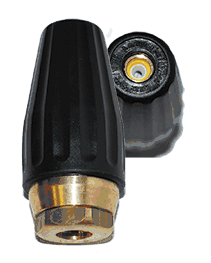
The Suttner ST-357 turbo nozzle for pressure washers spins a zero-degree pencil jet in a fast circular pattern, combining the punch of a red tip with the coverage of a fan spray. It cleans concrete, removes paint, and strips years of buildup roughly 40% faster than a standard nozzle tip. Rated to 3600 PSI with a 4.0 orifice size. Threaded 1/4" MPT connection fits most contractor wands and lances.
This is the turbo nozzle most Mid-Atlantic contractors keep on their rig. Suttner builds it with a ceramic turbine seat that holds up to daily commercial use. When a $6 nozzle tip is not cutting through the grime fast enough, this is what you reach for.
How a Turbo Nozzle Works (and Why It Cleans Faster)
A standard quick connect nozzle tip sprays water in a fixed fan pattern. A turbo nozzle takes that same water stream and spins it in a tight cone. The spinning action concentrates impact force on a smaller area with each rotation while still covering a wider path than a 0 degree tip.
The result: you get 0-degree cleaning power spread across a 25-degree coverage area. That means you can clean a concrete driveway in roughly half the passes it takes with a green 25 degree fan tip. Less time on the job, more jobs per day.
| Feature | Turbo / Rotating Nozzle | Standard 25 Degree Fan Tip |
|---|---|---|
| Impact Force | 10x higher per square inch | Baseline |
| Coverage Pattern | Spinning cone (approx 25 degrees) | Fixed fan (25 degrees) |
| Cleaning Speed on Concrete | Up to 40% faster | Standard speed |
| Surface Damage Risk | Higher - not for soft surfaces | Lower - safe for most surfaces |
| Best For | Concrete, brick, stone, metal, paint removal | General cleaning, decks, fences, siding |
Where Contractors Use the ST-357 Rotating Nozzle
Concrete driveways and sidewalks. This is where turbo nozzles earn their keep. The spinning jet cuts through tire marks, oil drips, oxidation, and ground-in dirt that flat fan tips barely touch. Most contractors use the turbo nozzle for the initial heavy cleaning pass, then follow up with a surface cleaner for the final uniform finish.
Parking garages and loading docks. Commercial concrete covered in tire rubber, hydraulic fluid, and years of foot traffic. The ST-357 handles all of it without needing chemical pre-treatment on most jobs.
Paint stripping and prep work. When you need to remove old paint from concrete, brick, or block walls, the turbo nozzle strips it mechanically without chemicals. Faster than a yellow 15 degree tip and covers more area per pass.
Graffiti removal on masonry. The concentrated rotating jet blasts paint off brick, block, and stone surfaces. Start from a distance and work closer until you find the right standoff distance for the surface you are cleaning.
Suttner ST-357 Turbo Nozzle Specifications
| Spec | Detail |
|---|---|
| Brand | Suttner |
| Model | ST-357 |
| Nozzle Type | Rotating Turbo Nozzle |
| Max Working Pressure | 3,600 PSI |
| Orifice Size | 4.0 |
| Connection | 1/4" MPT (Male Pipe Thread) |
| Rotation Speed | ~3,800 RPM |
| Spray Pattern | Spinning 0 degree jet in a cone pattern |
| Max Temperature | 212 degrees F (100 degrees C) |
| Turbine Material | Ceramic seat |
| Body Material | Brass |
How to Pick the Right Turbo Nozzle for Your Machine
Two things matter: PSI rating and orifice size.
PSI rating. Never run a turbo nozzle on a machine that exceeds the nozzle's rated pressure. The ST-357 is rated to 3600 PSI. If your machine runs higher than that, look at the Suttner ST-457 (rated to 6000 PSI) or the Viper 5000 PSI rotating nozzle.
Orifice size. The 4.0 orifice on this model is matched for machines running 3.5 to 4.0 GPM. If your machine runs lower GPM, you need a smaller orifice turbo nozzle. If it runs higher, you need a larger one. Using the wrong orifice size means the nozzle will either restrict your flow (too small) or lose cleaning power (too large).
| Your Machine GPM | Recommended Turbo Nozzle Orifice |
|---|---|
| 2.0 - 2.5 GPM | 2.5 - 3.0 |
| 2.5 - 3.5 GPM | 3.0 - 3.5 |
| 3.5 - 4.0 GPM | 3.5 - 4.0 (this model) |
| 4.0 - 5.5 GPM | 4.5 - 5.5 |
Installation: How to Connect a Turbo Nozzle
The ST-357 has a 1/4" male pipe thread (MPT) connection. It threads directly onto any pressure washer wand or lance that has a 1/4" female pipe thread (FPT) outlet.
Step 1: Wrap two layers of PTFE tape around the male threads.
Step 2: Hand-tighten into the wand outlet.
Step 3: Snug with a wrench. Do not overtighten brass fittings.
Step 4: Squeeze the trigger and listen for smooth, consistent rotation. If the nozzle wobbles or stalls, shut down and check for debris in the inlet screen.
If your wand has a 1/4" quick connect socket instead of threads, you will need a QC plug to 1/4" FPT adapter. We carry those in our fittings collection.
Turbo Nozzle Maintenance Tips
Flush after every job. Run clean water through the turbo nozzle for 30 seconds at the end of each job. Chemical residue (especially bleach) corrodes the ceramic seat and eats through internal o-rings.
Clear debris immediately. If the nozzle stops spinning mid-job, there is probably sand or grit stuck in the turbine. Remove the nozzle, soak it in warm water, and blow compressed air through the inlet. Most of the time this fixes it.
Replace when rotation slows down. Over time the ceramic seat wears and the turbine slows. When your turbo nozzle no longer spins at full speed, your cleaning power is dropping and it is time for a new one. Most contractors get 6 to 18 months out of a turbo nozzle depending on usage.
Frequently Asked Questions About Turbo Nozzles
What is a turbo nozzle for a pressure washer?
A turbo nozzle (also called a rotating nozzle or rotary nozzle) is a pressure washer attachment that spins a zero-degree water jet in a fast circular pattern. It delivers the concentrated impact of a pinpoint stream spread over a wider cleaning path. The result is dramatically faster cleaning on hard surfaces like concrete, brick, and stone.
Is a turbo nozzle worth it?
If you clean concrete regularly, absolutely. A turbo nozzle cuts job time by 30 to 40 percent on hard surfaces compared to a standard 25 degree fan tip. At around $80, it pays for itself in saved labor on the first or second job. For house washing and soft surfaces, stick with your regular nozzle tips.
Can I use a turbo nozzle on wood or siding?
No. The concentrated spinning jet will gouge wood, damage vinyl siding, and strip paint from any coated surface. Turbo nozzles are for hard surfaces only: concrete, brick, block, stone, and metal. Use a 25 or 40 degree fan tip for wood, siding, and painted surfaces.
What is the difference between a turbo nozzle and a surface cleaner?
A turbo nozzle is a single spinning jet you hold with your wand. A surface cleaner is a round housing with two or more spinning nozzle tips underneath that you roll across flat surfaces. Surface cleaners give you a more uniform finish with no striping, but turbo nozzles are better for spot cleaning, edges, curbs, and areas a surface cleaner cannot reach. Most contractors use both.
Why did my turbo nozzle stop spinning?
The most common cause is debris (sand, grit, or chemical residue) stuck in the turbine. Remove the nozzle, soak it in warm water, and blow compressed air through the inlet. If it still will not spin after cleaning, the ceramic seat is cracked and the nozzle needs to be replaced.