


Nickel Plated 3/8" FPT 7000 PSI Ball Valve
Nickel Plated 3/8" FPT 7000 PSI Ball Valve
- Order Policies
- Item# 4997
Couldn't load pickup availability

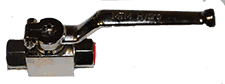
High Pressure Ball Valve for Pressure Washers — 3/8" FPT, 7,000 PSI Rated
This nickel-plated high pressure ball valve gives you instant on-off flow control anywhere in your pressure washing system. Rated to 7,000 PSI with 3/8" female pipe thread ports on both sides, it handles the full output of any contractor-grade pressure washer without restriction, leaking, or failure under load.
Ball valves are one of those parts that every contractor needs but nobody thinks about until something goes wrong. Need to shut off flow to swap a nozzle without walking back to the machine? Ball valve. Running a dual-gun setup and want independent control? Ball valve on each line. Winterizing the rig and need to isolate sections for blowout? Ball valve. Once you add one, you will wonder how you ran without it.
Why This Ball Valve Stands Apart
7,000 PSI working pressure. Most ball valves sold for pressure washing are rated at 3,000 to 5,000 PSI. This one is rated to 7,000 PSI, which gives you a real safety margin on a 4,000 PSI machine. That margin matters when pressure spikes hit during cycling — spikes that can exceed your pump's rated output by 30 percent or more. A valve rated too close to your operating pressure will fail at exactly the wrong moment.
Nickel-plated steel body. The nickel plating resists corrosion from water, chemicals, and the constant wet-dry cycling that eats bare steel fittings alive. Contractors running sodium hypochlorite, degreasers, and other chemicals through downstream injectors need fittings that will not pit and seize. This valve holds up season after season.
Full-port design. A full-port ball valve means the internal bore matches the pipe size — there is no restriction when the valve is open. Cheaper ball valves use a reduced port that chokes flow, drops pressure, and starves your nozzle. With a full-port 3/8" valve, you get the same flow as if the valve was not there at all.
Quarter-turn operation. Open or closed in a quarter turn of the handle. No threading, no multiple rotations, no guessing whether it is fully open. Flip it and go. The handle position tells you the valve state at a glance — parallel to the pipe means open, perpendicular means closed.
Specifications
- Max Working Pressure: 7,000 PSI
- Port Size: 3/8" Female Pipe Thread (FPT) both sides
- Port Type: Full port — no flow restriction when open
- Body Material: Carbon steel with nickel plating
- Ball Material: Stainless steel
- Seal Material: PTFE seats with Buna-N O-rings
- Operation: Quarter-turn lever handle
- Max Temperature: 250 degrees F
- Weight: Approximately 0.75 lbs
Where to Install a Ball Valve on Your Rig
There are several common installation points where a ball valve makes your rig more efficient and easier to maintain:
Between the pump and the hose reel. This is the most common placement. It lets you shut off flow to the reel without killing the engine. Useful when swapping hose connections, bleeding air from the system, or isolating the reel for maintenance.
At the gun inlet. Some contractors add a ball valve at the gun inlet as a secondary shutoff. This is especially useful on long hose runs where walking back to the truck to shut off the main line wastes time.
On a chemical injection line. Ball valves on your downstream injector supply line let you turn chemical flow on and off independently from water flow. Run plain water to rinse, flip the valve to pull chemical for the next application.
On dual-gun manifolds. When running a two-gun setup from a single pump, each line gets its own ball valve so one operator can shut down without affecting the other.
At the buffer tank outlet. A ball valve between your buffer tank and the pump inlet lets you control water supply during priming, troubleshooting, or when you need to disconnect the tank.
Installation Tips
Apply PTFE thread sealant tape to the male fittings going into each side of the valve. Use three to four wraps and make sure the tape does not overhang into the bore — tape fragments in the ball can prevent full closure. Thread the fittings in hand-tight, then snug with a wrench. Do not over-torque — the nickel plating can crack if you gorilla the fittings.
Mount the valve with the handle accessible. This sounds obvious, but on a tight rig build, it is easy to bury a valve behind the pump or under the reel where you cannot reach the handle without taking off gloves and reaching into a tight space. Plan your plumbing so the handle swings freely.
Maintenance
Ball valves are low maintenance, but they are not zero maintenance. At the end of every work day, cycle the valve open and closed a few times while water is flowing to flush debris from the ball and seats. At the end of the season, remove the valve and inspect the ball and PTFE seats for scoring or chemical damage. Replace the valve if the ball shows pitting or the seats are grooved — a leaking ball valve is worse than no valve at all.
In freezing weather, drain the valve completely or blow it out with compressed air. Water trapped inside will freeze, expand, and crack the body.
Frequently Asked Questions
Can I use this ball valve for hot water pressure washers?
Yes, up to 250 degrees F. For steam applications above that temperature, you need a valve with higher temperature-rated seals. Check your machine's outlet temperature before selecting.
Will this valve work with chemicals like sodium hypochlorite?
The nickel plating and stainless steel ball hold up well to most pressure washing chemicals including SH, degreasers, and acid-based cleaners. For continuous chemical contact, stainless steel ball valves offer even better resistance — but for downstream injection where chemical exposure is intermittent, this valve performs well.
What is the difference between FPT and MPT?
FPT means Female Pipe Thread — the threads are inside the fitting. MPT means Male Pipe Thread — the threads are outside. This valve has FPT on both sides, so you will thread male fittings, nipples, or quick connect plugs into it.
Why 3/8" and not 1/2"?
3/8" is the standard high pressure plumbing size for most contractor-grade pressure washers running 3 to 5.5 GPM. If you are running an 8 GPM machine with 1/2" plumbing throughout, you need a 1/2" valve. For the vast majority of single-gun rigs, 3/8" is correct.
How do I know if the valve is open or closed?
Handle parallel to the pipe = open. Handle perpendicular to the pipe = closed. Every time.
Related Products
Build out your plumbing with these contractor-grade fittings from Sun Brite Supply:
- Quick Connect Fittings — Stainless steel and brass QC plugs and sockets in 1/4" and 3/8"
- Swivels — High pressure swivels to prevent hose twist
- Hose Reels — A-frame and aluminum reels with stainless plumbing
- Pressure Washer Hoses — Non-marking high pressure hoses in 50' and 100' lengths
- Fittings and Adapters — Nipples, bushings, tees, and elbows for custom plumbing
In stock and ships same day from Sun Brite Supply in Gaithersburg, Maryland. We keep these on the shelf because they are the kind of part you need yesterday. Call us if you have questions about fitting this into your rig.