

Whip Lines for Pressure Washers - 3/8" & 1/2"
Whip Lines for Pressure Washers - 3/8" & 1/2"
- Order Policies
- Item# 5830
Couldn't load pickup availability
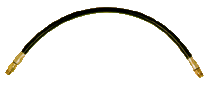
What Is a Pressure Washer Whip Hose?
A whip hose — also called a jumper hose, leader hose, or whip line — is a short, flexible high pressure hose that sits between your trigger gun and your main hose, or between the pump outlet and your hose reel inlet. It absorbs the constant bending, twisting, and vibration that would otherwise destroy the first few feet of your main pressure washer hose or stress your hose reel swivel to the point of failure.
Think of it this way: every time you pull the trigger, pressure spikes through the system. Every time you walk around a corner, the hose bends sharply at the connection point. Without a whip line taking that abuse, you are wearing out the most expensive hose on the reel — a 100 or 200 foot section that costs ten times what a short jumper costs to replace.
Why Every Contractor Runs a Whip Line
Professional pressure washing contractors do not run their main hose directly off the pump or directly into the gun. They use a whip hose at both ends. Here is why:
Protects your main hose investment. A 100-foot section of quality 3/8" pressure washer hose runs well over $100. The last 3 to 6 feet nearest the gun or pump take 90 percent of the bending stress. When that section fails, you replace the whole hose — or you cut it and lose length. A whip line takes all that abuse for a fraction of the cost, and when it wears out, you swap it in two minutes.
Reduces hose reel stress. Between the pump outlet and the reel inlet, the hose makes a tight turn. Without a flexible whip to absorb that bend, the rigid main hose puts side-load on your reel swivel. That leads to leaks, blown seals, and a reel swivel replacement that costs far more than a whip line ever would.
Prevents kinking. The double-wire braid construction in these whip lines is specifically designed to stay flexible under pressure. A main hose can kink at the connection point, especially in cold weather. The whip line flexes where the main hose would kink, keeping your flow consistent and your pressure steady.
Absorbs vibration. Pressure washer pumps produce vibration. That vibration travels through rigid connections and wears out fittings. A short whip line between the pump and the reel acts as a vibration dampener, extending the life of every fitting downstream.
Specifications
- Inner Diameter: Available in 3/8" and 1/2" ID
- Lengths: 2 foot, 3 foot, 4 foot, 5 foot, and 6 foot options
- Max Working Pressure: 4,000 PSI (3/8") and 3,000 PSI (1/2")
- Construction: Double steel wire braid reinforcement with synthetic rubber inner tube
- Jacket: Non-marking, abrasion-resistant cover
- End Fittings: 3/8" MPT swivel x 3/8" MPT fixed (3/8" models); 1/2" MPT swivel x 1/2" MPT fixed (1/2" models)
- Temperature Rating: Up to 250 degrees F
- Burst Pressure: 16,000 PSI (4x safety factor)
Which Size Do You Need?
3/8" whip hose fits most standard contractor-grade pressure washers running 3 to 5 GPM. This is what goes between your trigger gun and the main 3/8" high pressure hose, or between the pump and the hose reel on a standard 4 GPM cold water rig. If you are running a 4 GPM machine at 4,000 PSI, the 3/8" whip in a 3 to 4 foot length is the sweet spot.
1/2" whip hose is for higher volume machines — 5.5 GPM and up, or hot water rigs where you need the larger bore to handle the flow without restriction. If you are running an 8 GPM hot water skid, you want the 1/2" whip between the pump and the heater coil, and between the heater coil and the hose reel.
Length selection matters. A 2-foot whip works when the connection points are close together — like pump outlet to a reel mounted directly above. A 4-foot or 6-foot whip gives more flexibility for setups where the reel is offset from the pump, or when you want more range of motion at the gun end.
How to Install a Whip Hose
Installation takes about 60 seconds and requires no special tools beyond a wrench:
At the gun end: Thread the fixed end of the whip line into your trigger gun's outlet. Connect the swivel end to the first quick connect fitting on your main hose. The swivel end goes on the hose side so the whip can rotate freely without twisting.
At the pump or reel end: Thread the fixed end into the pump outlet or unloader valve. Connect the swivel end to the reel inlet or the first fitting leading to your main hose. Again, the swivel faces the side that moves.
Use thread sealant tape on all NPT connections. Snug with a wrench — do not over-torque. Pressure test before you start the job.
When to Replace Your Whip Line
Inspect your whip hoses every week. Replace immediately if you see any of these:
- Outer jacket is cut, abraded through to the wire braid, or bubbling
- Fittings are leaking and re-taping does not fix it
- The hose has a permanent kink or flat spot
- You notice a pressure drop that goes away when you bypass the whip
- The swivel end no longer rotates freely
Most contractors replace whip lines every 6 to 12 months depending on use. They are a wear item — that is the whole point. Better to replace a $30 whip than a $150 hose.
Common Setups
Standard cold water rig: 3/8" x 4' whip from pump to reel, 3/8" x 3' whip from hose to gun.
Hot water skid: 1/2" x 4' whip from pump to heater coil, 1/2" x 4' from heater coil to reel.
Soft wash rig: Use a 1/2" whip on the supply side if running high volume through the reel.
Frequently Asked Questions
What is the difference between a whip hose and a regular pressure washer hose?
A whip hose is built shorter and more flexible than a standard high pressure hose. It is designed to absorb bending stress and vibration at connection points. A regular pressure washer hose is built for length and durability over long runs. You use both — the whip protects the main hose from premature failure at the ends.
Can I use a whip hose as my main hose?
No. Whip hoses only come in short lengths (2 to 6 feet) and are not designed for the distance you need on a job. They serve a specific purpose — protecting connections and absorbing stress.
Do I need a whip hose at both ends?
Most contractors run one at each end — one between the pump/reel and one between the hose/gun. At minimum, run one at the pump end where vibration and tight bends cause the most damage.
Will a whip hose reduce my pressure?
Not in any measurable way. The short length means negligible pressure drop. Make sure you match the ID to your system — 3/8" for standard rigs, 1/2" for high volume.
What PSI rating do I need?
Match or exceed your pump's rated pressure. Our 3/8" whip lines are rated to 4,000 PSI with a 16,000 PSI burst rating, which covers virtually every contractor-grade cold water machine. For hot water rigs, check the temperature rating as well.
Related Products
Complete your hose setup with these contractor-grade accessories from Sun Brite Supply:
- Pressure Washer Hoses — 3/8" and 1/2" non-marking high pressure hoses in 50' and 100' lengths
- Hose Reels — A-frame and flat-mount reels with stainless swivels
- Quick Connect Fittings — Stainless steel and brass QC plugs and sockets
- Swivels — High pressure swivels rated to 5,000 PSI to eliminate hose twist
- Spray Guns — Suttner and PA trigger guns for daily contractor use
Ships same day from Sun Brite Supply in Gaithersburg, Maryland. We stock every size and length so you are never waiting on a part that should have been on the truck yesterday. Questions? Call us — we are contractors too and we know what works.